

Share This Article
Although English is widely spoken in tourist areas of Thailand, knowing a few key phrases in the local language can greatly enhance your travel experience. By adding these eight essential Thai phrases to your travel toolkit, you can immerse yourself in the vibrant culture of Thailand and communicate more effectively with the locals.
Before you read: Following every Thai phrase and sentence, you will hear the words “Krub” and “Ka” quite consistently. These two sentence endings add politeness to the sentence. Male speakers will use “Krub” and female speakers will use “Ka” (unless they are on a super friendly term, then you won’t hear them use these.) Our selected phrases below will help you understand this better.
1. Sawasdee krub/ka

Meaning: Hello/Goodbye
The quintessential Thai greeting, “Sawasdee,” is your key to opening friendly conversations and bidding farewell with warmth. It sets a positive tone for interactions, making locals appreciative of your effort to embrace their language.
2. Khob Khun krub/ka

Meaning: Thank you
Expressing gratitude is universal; in Thailand, saying “Khob Khun” with a smile can create a positive connection with locals. It reflects appreciation for the warmth and hospitality you will undoubtedly encounter.
3. Kor Tod krub/ka
Meaning: I’m sorry/ Excuse me
Mistakes are bound to happen, and saying “Kor Tod krub/ka” can ease the situation and sometimes bring an endearing smile to the face. Most of the time, though, you will need this phrase when you want to ask a question, just like how you would use “Excuse me” or “Sorry to bother you.”
Now that we have covered the top three phrases, let’s look at some other sentences that will pop up as you roam around.
4. Un Nee Kue Arai krub/ka?
Meaning: What is this?
Visiting a new country can be fascinating, and without a doubt, you will have many questions. The top question would be to figure out the food to order or products to buy.
The word “Un nee” means “This”. You can change it to “Un nun” to mean “that” (Un nun kue arai krub/ka?)
If you want to sound like a pro, you can combine Phrase #3 and this one together: “Kor tod ka. Un nee kue arai ka?”
5. Un Nee Tao Rai krub/ka?
Meaning: How much is this? (Tao Rai = How much)
After knowing what the item is, you might want to know how much to spend on it. This is the phrase to remember.
Again, you can apply the same concept and change “Un nee” to “Un nun” to ask, “How much is that?” (Un nun tao rai krub/ka?)
But what if you think the price is a tourist price and you want to bargain? The next sentence will come in handy.
6. Lod Nhoi Dai Mai krub/ka?

Meaning: Can you give me a discount?
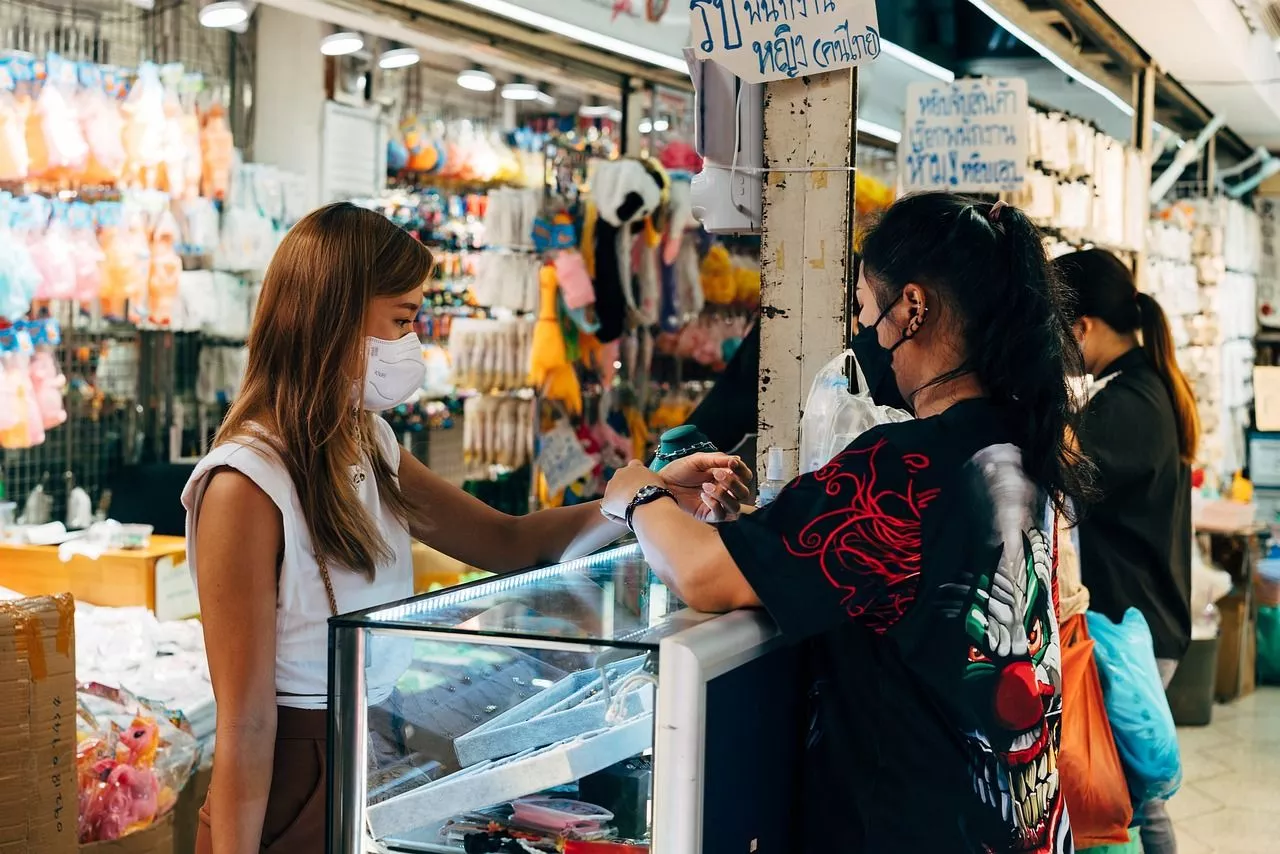
Haggling is a cultural norm in Thai markets, and uttering, “Lod Nhoi Dai Mai krub/ka?” (sometimes shortened to “Lod Nhoi Na” as “Na” means “Please”) with a friendly demeanor can lead to fair deals. Engage in the local shopping experience and make the most of your budget.
Pro tip: The word “Na” works like “Please”. The longer you drag on the sound “Naaaa” (in the same way you would say “Pleaseeeee”), the more pleading you are. But please don’t overdo it to maintain sincerity.
After asking a couple of questions about the item, you are ready to make a decision. What do you say?
7. Aow un nee krub/ka
Meaning: I will take this one. (Aow = Take)
You can also say, “Aow un nun krub/ka”, if you meant, “I’ll take that one.”
But wait, what if you decide not to buy it? You can say, “Mai aow krub/ka”. “Mai” means “no”, so this phrase means “I’m not taking it.”
However, it can come out rather rude. Here’s a better way to say no like Thais.
8. Mai Pen Rai krub/ka
Meaning: It’s okay/ No worries
Thai people use this phrase when they want to say no politely. This is like saying, “I’m good.” The term is usually used with a thank you, so you will hear, “Mai pen rai ka. Khob khun ka,” and then see the person leave the shop.
In another situation, you will most likely hear people say, “Mai pen rai,” as a response to an apology. For example, you are walking on the street and shoulder bump someone; you say, “I’m sorry”, and the other person will (most likely) reply, “Mai pen rai krub/ka.”
So yes, you will hear this phrase a lot, and you can use it to navigate situations with a relaxed vibe, embracing the laid-back Thai attitude like a true Thai.
9. [Place’s Name] Yoo Nai krub/ka?
Meaning: Where is [Place’s Name]?
While Google Maps is a tourist’s best friend on the trip, asking around is still helpful when there’s no internet connection or when you are in a building and trying to locate a particular shop or even a restroom!
For instance, if you are looking for a restroom (Hong Nam), you can ask “Hong nam yoo nai krub/ka?” (Where is the restroom?)
10. Chuai Duay!
Meaning: Help!
We hope you do not get to use this one, but in case of emergencies, this phrase can save you and ensure you receive the help you need. Adding the polite ending “Chuai duay krub/ka” is a common variation.
Remember that Thai people are very friendly and keen to help, so feel free to reach out.
There you have it! The top essential phrases that will be most helpful during your stay in Thailand. Beyond being practical tools, these words unlock doors to authentic cultural exchanges. Embrace the spirit of Thailand, connect with locals, and savor the beauty of a journey enhanced by language.